
| animal | Canine |
| Sample type | Serum,plasma |
| Sample volume | 75μL |
| 39-86 °F storage | 24 months shelf life |

 Animal canine
 Sample Type Plasma, Serum
 Measurement Range 0.1-10 mg/L
  Testing Time 15 Minutes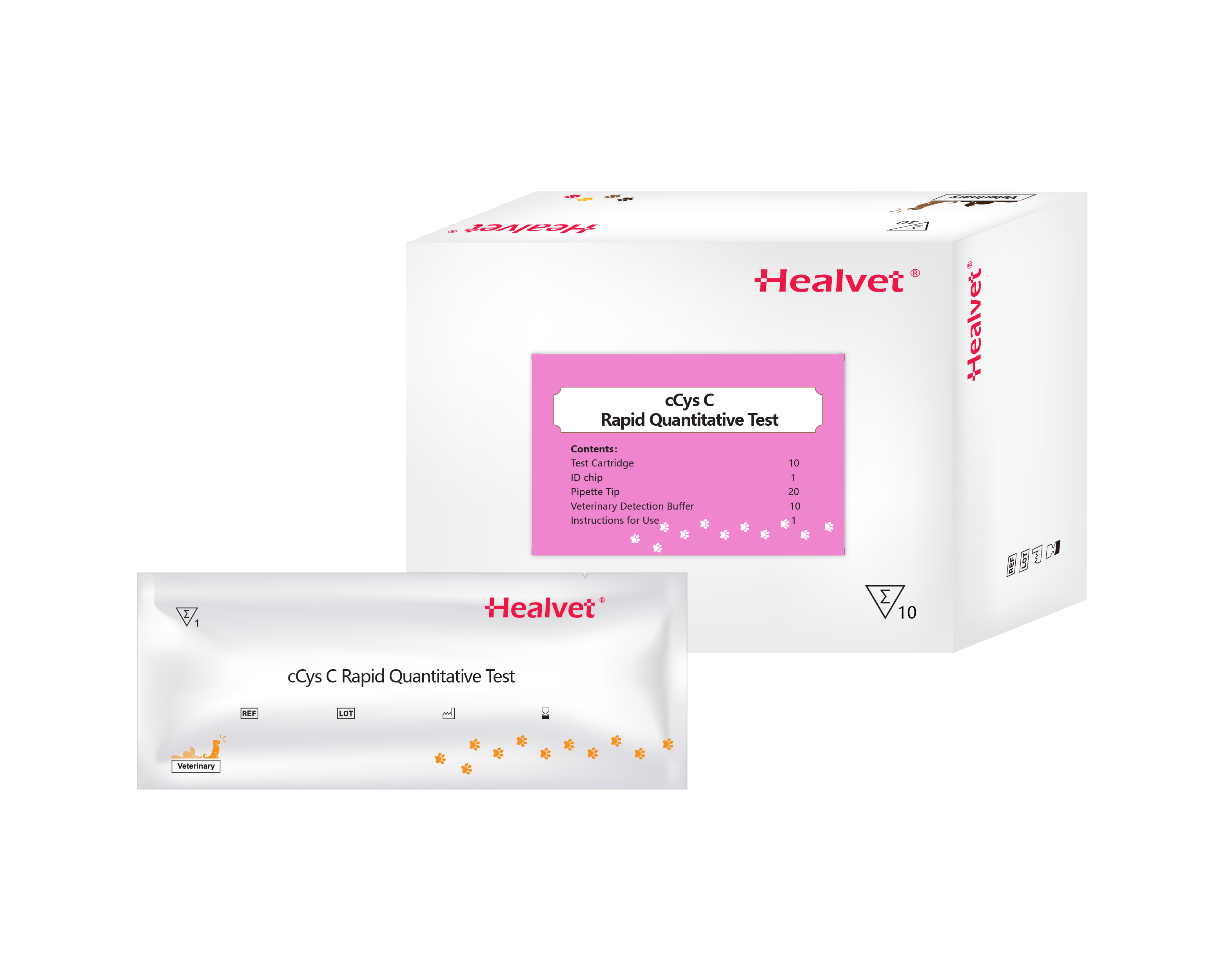
Canine Cystatin C, a protein belonging to the cystatin protease inhibitor family, is produced at aconstant rate by all nucleated cells and is an ideal endogenous marker whose concentrationin blood is almost entirely dependent on GFR. It is freely filtered by thekidneys and brokendown after absorption in the proximal tubule;in fact, it does not return to the blood unless the proximal tubule is injured. In nephrology, this endogenous substance is seen as a marker of renal excretory function and is more sensitive than creatinine.
| animal | Canine |
| Sample type | Serum,plasma |
| Sample volume | 75μL |
| 39-86 °F storage | 24 months shelf life |
| Normal | <1.2 mg/L |
| Suspected kidney injury | 1.2-1.5 mg/L |
| Kidney injury | >1.5 mg/L |
Canine Cystatin C Rapid Quantitative Test is a fluorescence immunoassay used along with Healvet 3000 analyzer for quantitative determination of cCys C concentration in canine serum or plasma specimen. The test is used as an aid to kidney injury inspection
Step 1: Sample Preparation
Add 75 µL of serum or plasma sample into the buffer tube.
Mix thoroughly without forming bubbles.
Step 2: Sample Application
Transfer 75 µL of the prepared mixture into the sample well of the test card.
Step 3: Result Analysis
Insert the test card into the Healvet 3000 Analyzer with standard test mode.
Read and record the test result according to the analyzer instructions.